
Why a country with no litter has no bins
The first surprise in Tokyo: the streets are spotless and there isn't a bin for a kilometre. That's not an accident. Bins were removed from stations en masse after the 1995 sarin attack on the Tokyo subway, for security reasons. It stayed that way, and residents simply got used to taking their rubbish home.
What this means for you: keep a small bag for rubbish in your daypack. That's what Japanese people do and it's the simplest way to get through a day in the city.
Where you can actually throw things away
- Convenience stores (7-Eleven, FamilyMart, Lawson) - bins stand by the entrance or next to the till. More and more often they're moved inside, precisely because of tourists.
- Stations and platforms - usually past the gates, near kiosks and vending machines.
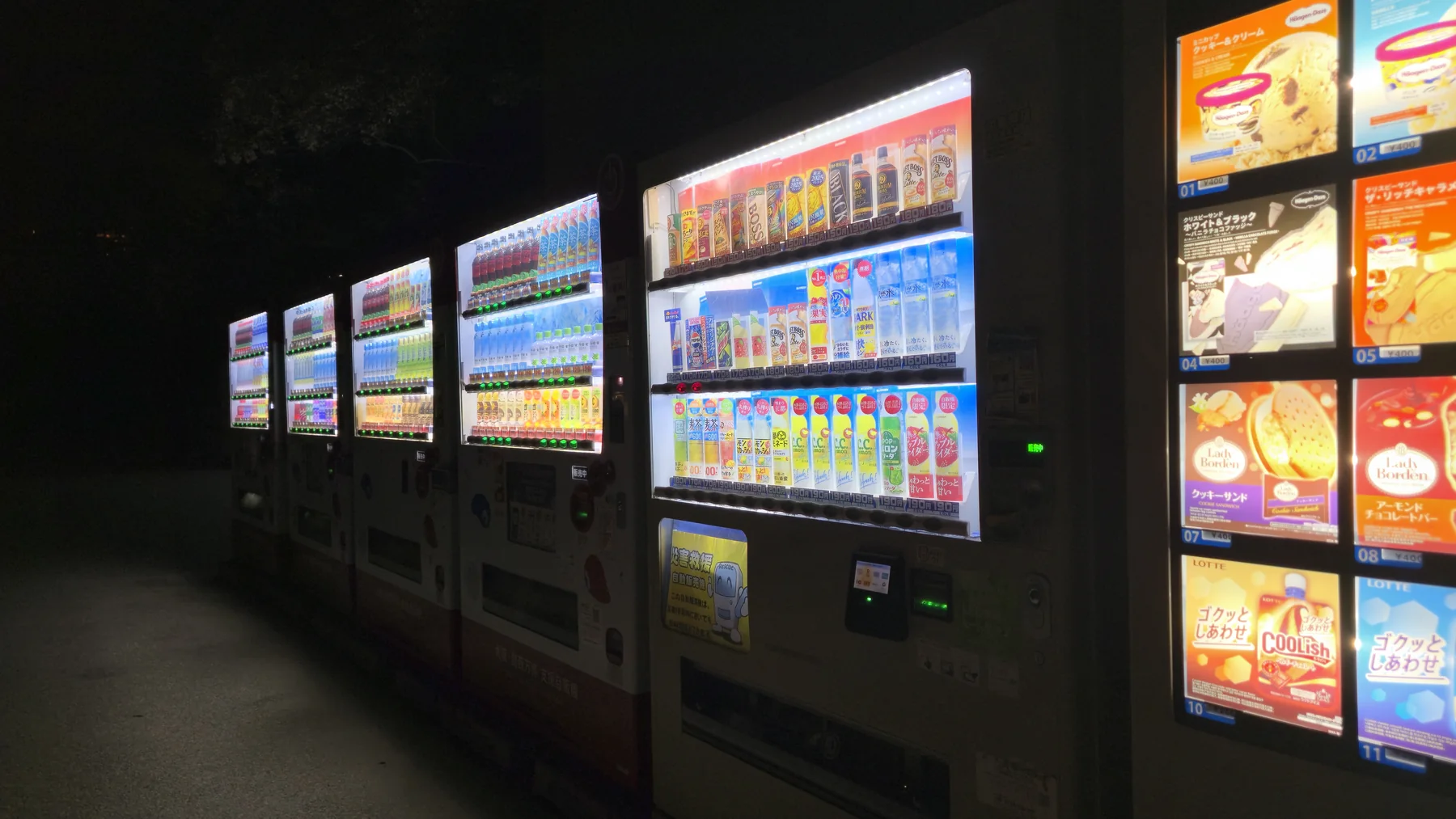
- Vending machines - there's almost always a container next to them, but only for what the machine sells: cans and bottles. A sandwich wrapper doesn't belong there.
- Shopping centres, food courts, museums, theme parks - no shortage of bins here, just like at home.
- Your hotel - the room usually has two or three labelled bins.
The biggest tourist mistake
Don't carry a bag of rubbish from your hotel or Airbnb to a convenience store. Those bins are for what you bought in that shop, not for household waste. It's the most common reason shops hide their bins behind the counter or remove them. Throw household rubbish away at the hotel, and on the street only what you consumed on the street.
Categories, colours, and why every city does it differently
First things first: sorting rules are set by the municipality, not the state. There is no national standard for colours or for the number of categories. What is yellow in Kyoto may be blue in Sapporo. Don't memorise colours - they're a shortcut, not a rule.
The good news: anywhere sorting is required there's a card or sticker with pictures showing what goes where. At the station, in a convenience store, in your hotel room, by the bins at an apartment block. Usually with drawings, often in English too. When in doubt, read the card rather than the colour.
What you'll meet most often, and in what colours:
- 燃えるゴミ / 可燃ごみ - burnable. Food scraps, tissues, paper wrappers, wooden chopsticks. The public bin is usually grey or dark, with a wide opening.
- ペットボトル - PET bottles. Most often blue, with a round hole in the lid the size of a bottle neck. That hole is a safer clue than the colour.
- カン cans and ビン glass - usually yellow or silver, sometimes one container with two holes and a drawing of a can and a bottle.
- 燃えないゴミ / 不燃ごみ - non-burnable: metal, ceramics, small electronics. Often blue or green.
- プラ - plastic packaging: films, trays, caps. The プラ mark is printed on the packaging itself.
- 紙 - paper, newspapers, cardboard. Usually green, or tied up with string separately.
How much it varies: in Kyoto burnable waste goes in yellow municipal bags, recyclables in separate ones. In Tokyo there are no municipal bags at all - you use transparent ones and what matters is the collection day for each fraction. In a hotel none of this concerns you, because you get labelled bins ready to use.
For scale: the town of Kamikatsu on Shikoku sorts into 45 categories. An ordinary city has four to eight, so relax.
A PET bottle, step by step
This is the one thing worth memorising, because you'll do it every day:
- Take the cap off - it goes to plastic (プラ), not to PET.
- Peel the label - there's a vertical perforation, it comes off in one go. Also plastic.
- Rinse the bottle if you can. Juice residue ruins the whole bag.
- Crush it and drop it in the ペットボトル container.
A bottle thrown away with its cap and label is the most common foreigner mistake. Nobody will tell you off, but someone will have to take it apart after you.
Cigarettes, while we're at it
Dropping butts in the street is its own category of blunder. In many wards (Chiyoda, Shinjuku and Shibuya among them) smoking outside a designated area is prohibited and carries a fine of around 2,000 yen. Smoking areas are marked and usually have an ashtray - smoke there and put it out there.
💡 From me: a rubbish bag in your daypack and the habit of taking the cap off cover 90 percent of this. You'll pick up the rest in a week just by reading the labels on the bins.