
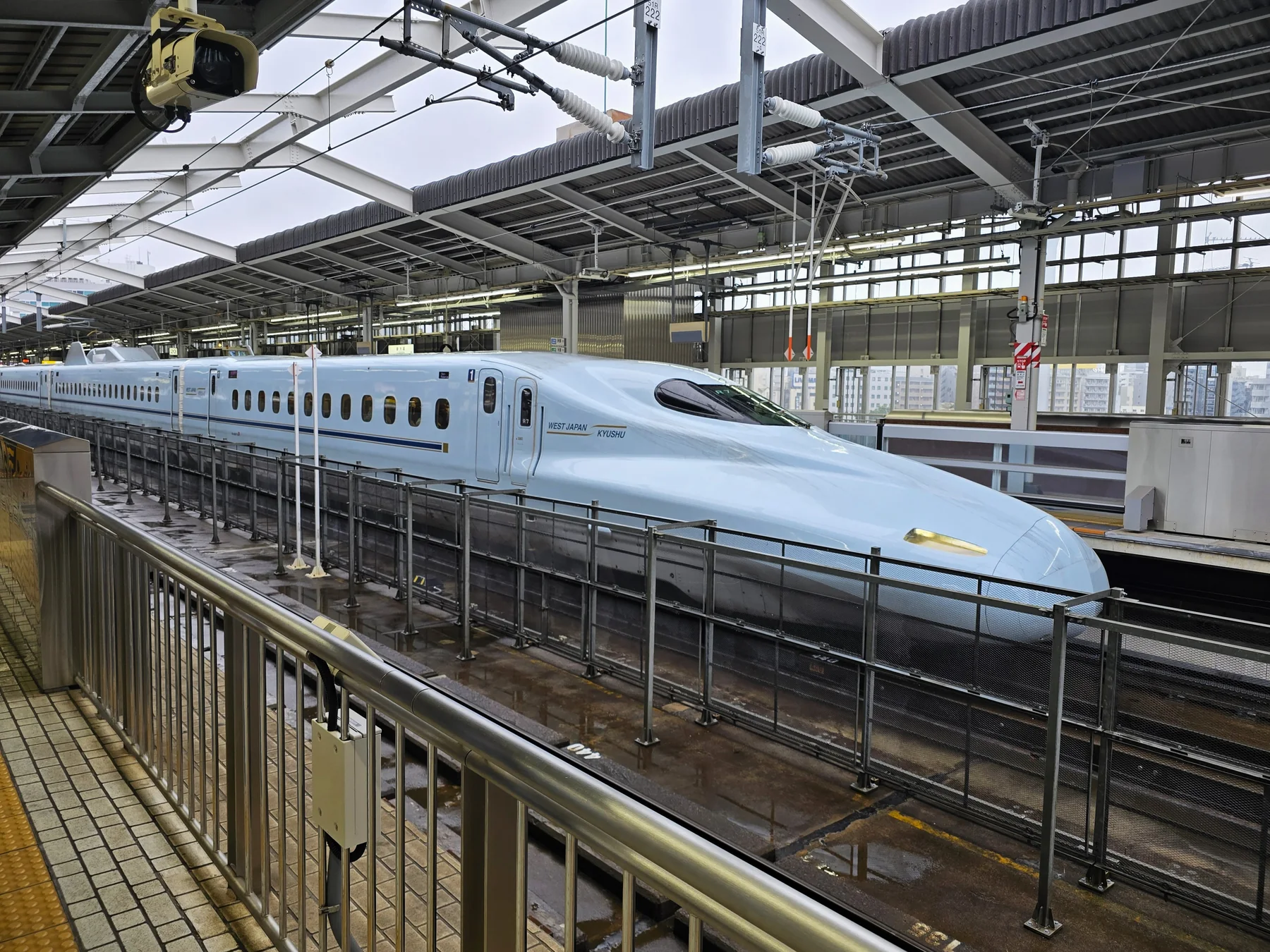
What it is and what changed
The JR Pass is a period ticket (7, 14 or 21 days) for most Japan Railways trains, shinkansen included. You buy once and stop counting fares.
In October 2023 it went up by roughly 70 percent: the 7-day ordinary version jumped from about 29,650 to 50,000 yen. That's the whole story - for years the pass was a no-brainer, today you have to sit down and do the maths.
Five minutes of maths
- List your long journeys. Don't count the metro or getting around town.
- Check single fares. Roughly: Tokyo - Kyoto about 14,000 yen one way, Kyoto - Hiroshima about 11,000, Tokyo - Kanazawa about 14,000.
- Add it up and compare with the pass.
Concretely: Tokyo - Kyoto and back is 28,000 yen. The pass costs 50,000, so you're roughly the same amount short again. Add Hiroshima or Kanazawa and the pass starts to win.
The rule: two long trips is not enough, three or more usually is.
Nozomi - the bit hardly anyone knows
The pass used not to cover the fastest Nozomi and Mizuho trains at all. Since the price rise you can ride them by paying a supplement for the leg. On Tokyo - Kyoto that's about 4,000 yen and saves you around 20 minutes compared with a Hikari.
Honestly: with a pass it's usually not worth it. The Hikari does that run in 2 hours 40 and is included.
When the pass doesn't pay off
- You're mostly in one city. Within Tokyo the JR Pass is close to useless - the metro belongs to other operators.
- You hop around on budget airlines (Peach, Jetstar) instead of trains.
- You travel slowly, with two moves in two weeks.
In Kansai the JR Pass doesn't pay off
Let's be blunt: around Kyoto, Osaka and Nara the nationwide pass is a weak choice. Distances are short, so single fares cost very little, and half the best connections belong to private railways - Hankyu, Keihan, Kintetsu, Nankai - which the pass doesn't cover at all. Getting to Nara, to Kōyasan or out to Lake Biwa means someone else's train and a separate ticket anyway.
Regional passes - usually the better idea
My recommendation for the classic route: the Kansai-Hiroshima Area Pass. Five consecutive days covering Kyoto, Osaka, Nara, Kobe, Himeji, Okayama, Hiroshima and the Miyajima ferry, plus the shinkansen between Shin-Osaka and Hiroshima. It covers exactly what you do in the second week of a trip and costs noticeably less than the nationwide pass. JR West has changed prices several times recently, so check the current one before buying.
- Kansai Wide - the same without Hiroshima, cheaper. Makes sense if you stay in Kansai.
- JR Kyushu - the whole island or just the north.
- Hokuriku Arch - Tokyo, Kanazawa, Osaka if you're doing a loop.
Very often a regional pass plus two single shinkansen tickets comes out at half the price of the nationwide one.
Seat reservations
Shinkansen seat reservations are free with a pass, at a machine or online (smartEX, EKINET). Worth doing, because in high season the unreserved cars fill up. With a big suitcase, book a seat in the last row - there's space behind it that fits luggage. On the Tokyo to Kyoto and Osaka route, oversized luggage space has to be reserved in advance.
What about a taxi from the airport?
To be straight with you: this is not cheaper by default. A taxi from Narita into central Tokyo costs 20,000 - 30,000 yen, while the Narita Express is about 3,000. A private transfer makes sense when:
- there are 3 - 4 of you with big suitcases and the fare splits between you,
- you land late at night, when the trains have stopped,
- you're travelling with a small child, or after a dozen hours in the air you have no energy for two changes with luggage.
The standard here is a Toyota Alphard or similar van: four people with luggage, soft seats, air conditioning. If you're alone or a couple landing during the day, the train wins hands down.
💡 From me: I run this calculation individually for your route. In roughly half the cases it turns out the pass is money thrown away - better to find that out before you buy.